

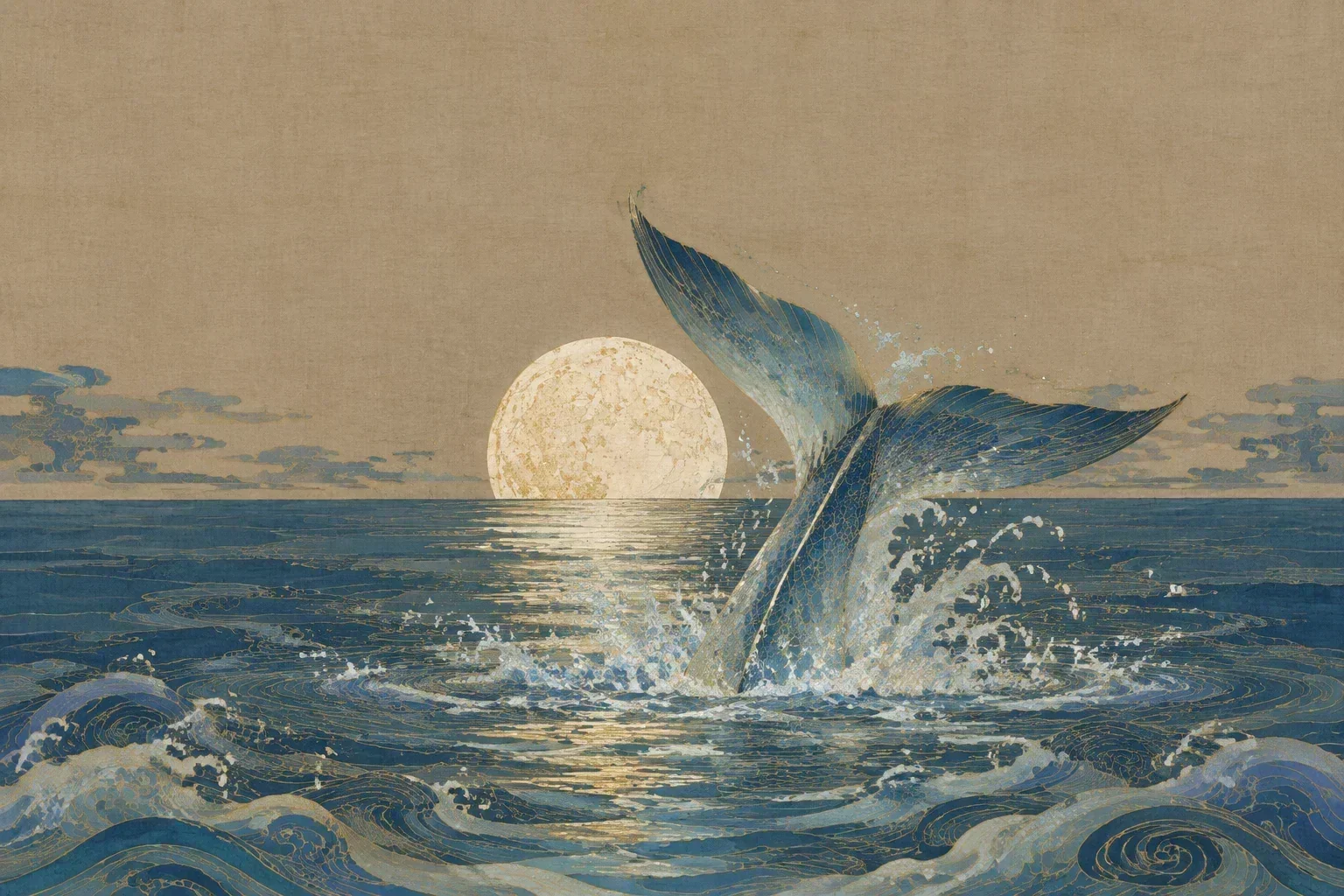
Of all the non-human leads in danmei and BL, the merman may be the oldest, and he comes with a structural problem no other monster shares. A vampire can walk out of his castle, and a fox spirit can pass for human in a city — but a merman has to return to the water at the end of the night, into the one element a human body cannot live in. The boundary between the two worlds is part of his body, so a merman romance never needs to explain why the two leads cannot simply move in together. That is why the trope is ancient on both sides of the ocean, and why the two shores developed it in such different ways.
The eastern merman — the jiaoren (鲛人) — has about two thousand years of documented history in Chinese writing. The earliest trace is a single gloss: the Shanhaijing’s land of the “painted foreheads,” where Guo Pu’s commentary identifies a southern coastal people who painted their faces and drew scales on their bodies as the jiaoren. By the Jin dynasty the figure had settled into the form readers still recognize. Gan Bao’s Soushenji (4th century) gives the classic description: beyond the South Sea live the jiaoren, who “dwell in water like fish, never neglect their weaving, and weep pearls from their eyes.” Zhang Hua’s Bowuzhi adds the best-known episode: a jiaoren comes ashore, lodges with a human household and sells his woven gauze for days; when he leaves he asks for a single basin, fills it with wept pearls, and pays for his stay and his thanks in one gesture. Ren Fang’s Shuyiji records his palace and his product — the Dragon-Gauze Palace, where the weave called xiaoxiao is so fine it never wets in water. The two fixed assets of the Chinese merman have not changed since: tears that turn into pearls, and cloth that becomes handkerchiefs. When Li Shangyin wrote in the blue sea, under the bright moon, pearls have tears, the image was already a thousand years old, and it has stayed in Chinese literature ever since.
The western mermaid began as a goddess and slowly became a warning. Around 1000 BCE the Assyrian goddess Atargatis — Derceto to the Greeks — threw herself into a lake over the death of a mortal lover and kept her human shape only from the waist up. The Greek sirens were not fish at all at first: in the Odyssey they are bird-women whose singing lures sailors onto the rocks, and only centuries of later artwork merged the siren and the mermaid into one creature. The colder northern seas kept their own relatives — the selkie who steps out of a sealskin, the rusalka who waits in the river. In 1811 Friedrich de la Motte Fouqué’s Undine gave the western mermaid her engine: a water spirit born without a soul, who can earn one only by marrying a human. Hans Christian Andersen read Undine and wrote the version the world remembers: in 1837 the little mermaid gives up her voice for legs, walks as if on knives, and watches the prince marry someone else. If the whole western river has one question, it is this: what will you pay to cross?
Seen side by side, the two traditions are the same story told with opposite temperaments. Both are romances in which one body literally cannot follow the other home, and both run on the same two organs — the eye and the throat. The eastern fish weeps pearls; the western fish sings storms. Either gift can turn beauty into currency, or consent into a weapon, depending on who ends up holding it. The difference is disposition. The jiaoren is a maker: he weaves, he sells, he repays a kindness with interest — a debtor rather than a predator. The siren is a hazard: beautiful, fatal, and safest at exactly the distance a love story will not allow. There is also a quieter difference that danmei and BL readers tend to notice. Western retellings overwhelmingly kept the fish female; the Chinese jiaoren was never assigned a fixed gender — 泉客, “the spring’s guest,” reads as whoever the story needs. When writers later built romances on both figures, the fish-tailed man required almost no justification. Both traditions were already there.
Modern danmei inherited the jiaoren almost directly. The best-known example today is Renyu Xianluo (《人鱼陷落》) by Lin Qian, often Englished as The Falling Merman: set in an ABO near-future, it pairs special agent Bai Chunian with Lan Bo, a merman commando — both former experimental subjects of the same research institute, which makes the tail both a weapon and a scar. The novel runs over a million Chinese characters and has been adapted into a manhua. An earlier classic is Deep Sea Mr.’s Desaro’s Merman (《德萨罗人鱼》): a biology student travels north to study mermaids and ends up becoming the specimen himself, courted inside a flooding deep-sea laboratory — a dark enough take that longtime readers still warn newcomers first. Tiantang Fangzhuzhe’s Sea Monster Alliance (《海怪联盟》) moved the siren into an apocalypse setting. On the comics side, the Korean manhwa Hooked and Cooked (written by Hwireul, drawn by Namdong, published on Lezhin in 2023) turns the Undine premise into a quiet rom-com: a sushi restaurant owner falls for a merman who needs human saliva to keep his legs, and offers one kiss a day until the arrangement stops being an arrangement. The Japanese Wadatsumi no Yometori plays the same material as folklore — a man who accidentally “marries” a merman and receives an immortality he never wanted.
Whatever the tradition, two of the oldest mechanisms keep doing the work. A voice that can compel makes silence meaningful, so a merman who refuses to speak says more than one who sings. And because the boundary is real, the ending stays binary: come ashore and pay with the sea, or return to it and pay with the shore.
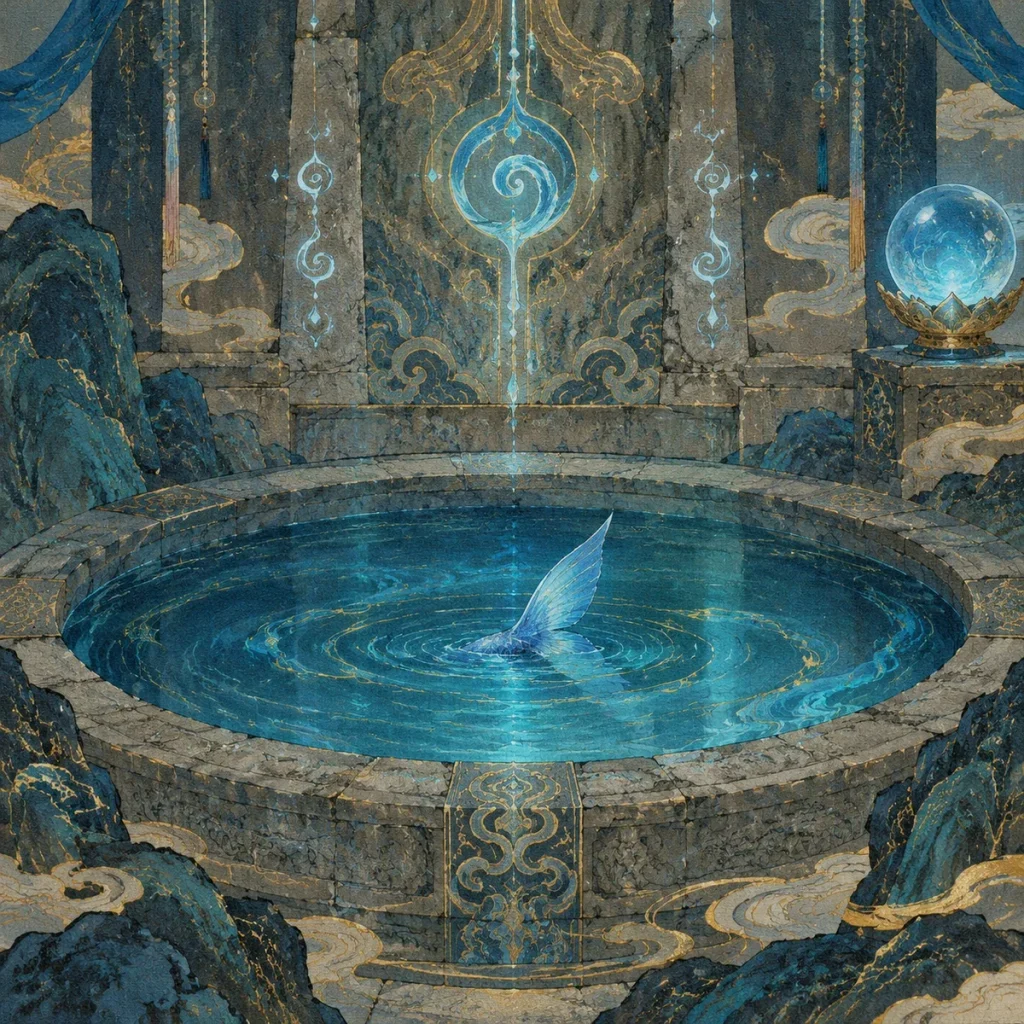
If the works above are the genre’s landmarks, the two below are the ones you can start today — one from each river, both free from the first chapter on our creations site. The western river first: in The Merman Prince in My Estate, Lord Vale signs what he believes is a contract for a merman companion on display, and spends months earning the trust of Lucian, the blue-tailed merman living in his moonwell, who answers every attempted touch with bared teeth. Then a message crystal lights up: the guild delivered the wrong merman. The contract on this one carries no consent clause for intimate contact, and if his boundaries are crossed his Alpha instincts may destabilize. Vale turns to leave — and the tail wraps around his waist and pulls him back. It is the siren’s oldest question rewritten as contract law: what does crossing cost, and who is allowed to pay. The eastern river answers in Song of the Sea Dragon: Prince Xiao Jue of the Great Jing Dynasty captures a rare merman, Lingxi, drawn by his beauty and his soul-catching song, and keeps him in a water prison hung with silks and jewels — everything except freedom. Where The Merman Prince asks the question through paperwork, Song of the Sea Dragon plays it as tragedy, and the official billing says exactly that: “a tragic tale of captivity, desire, and the price of freedom.” One courts you across a contract; the other sings from a golden room. Both are on the shelf now.
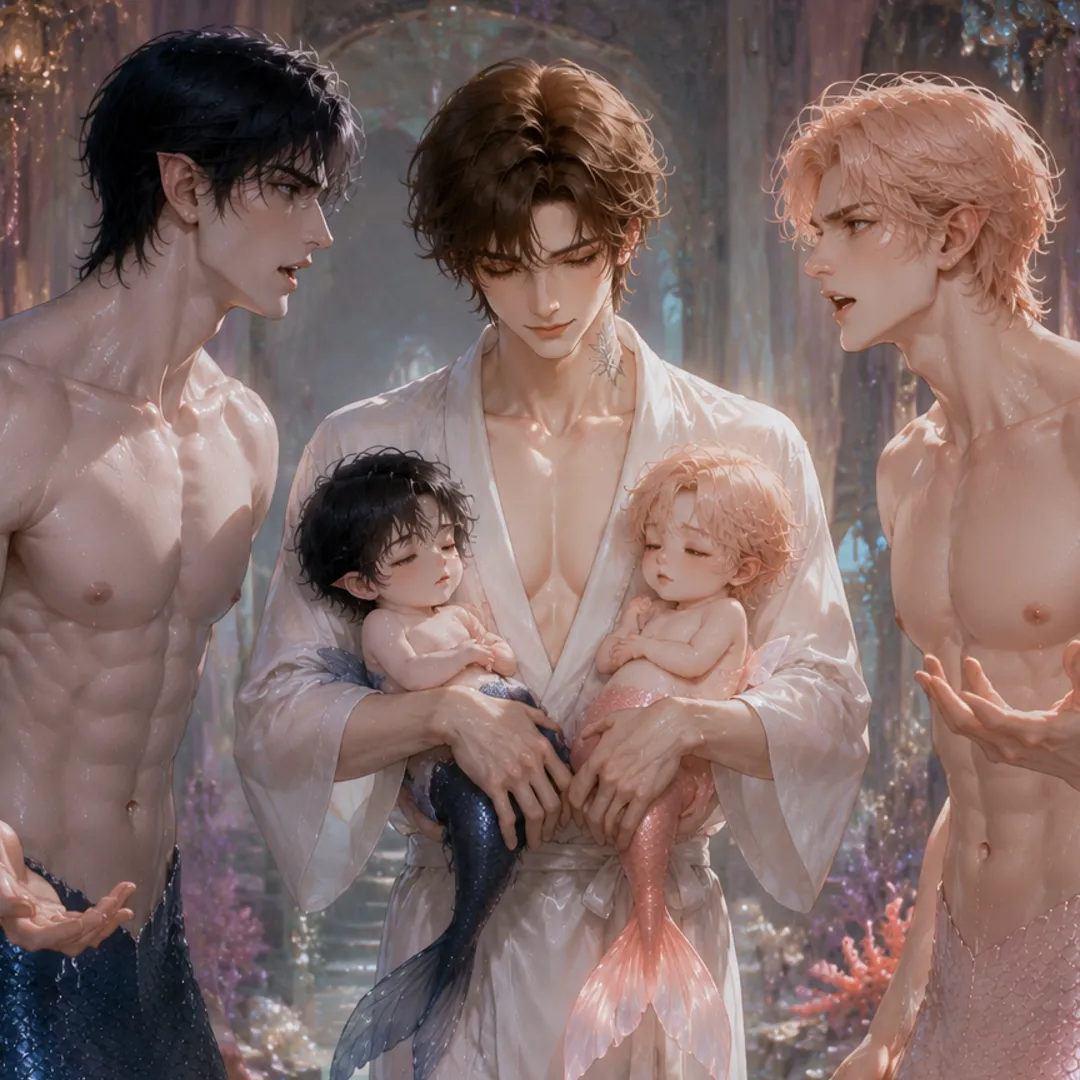

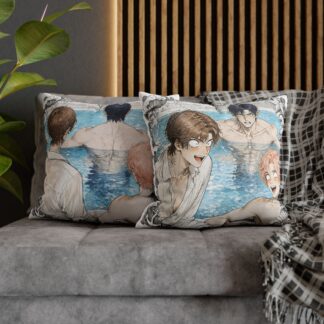
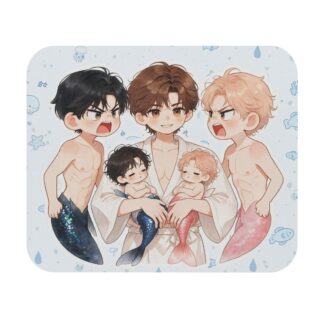
The shop has two merman pieces that grow out of the same theme. The When I Have Two Mermen throw pillow is printed on both sides: one face shows three characters by a pool — a brown-haired man in a soaked shirt, a sharp-eared merman in the water, and a pink-haired young man delighted about something he is not explaining — inside a vintage border of shells, starfish, anchors and waves; flip it over and the same three stand with their backs turned, looking at the water. It is a spun-polyester cover with a concealed zipper; the pillow insert is not included. The Who Is/Are Dad of the Little Mermaids? mouse pad is a chibi scene in the same register: a man in a white bathrobe holding two sleepy mermaid babies — one black-haired with a blue tail, one pale-gold with a pink tail — while a black-haired merman and a pale-gold merman glare at each other across the frame. One is for the sofa, one for the desk, and both are for readers who like their mermen with teeth.
The trope endures for a simple reason: the boundary never goes away. As long as people live on land and mermen live in the water, every generation gets to ask the question again, and every generation answers it a little differently. The jiaoren wept pearls over it. Andersen wrote it as a fairy tale with knives in it. Danmei put it in a contract and called it courtship. The next version is probably already being written.
FAQ
What’s the difference between a merman and a mermaid in romance?
Mostly the gender of the lead — merman is the term when the fish half is a man, which is the version danmei and BL readers care about. The mythology underneath (siren song, the lure, the boundary) stays identical.
Where does the eastern merman (jiaoren) come from?
The deep root is a Shanhaijing gloss — Guo Pu’s commentary identifies the painted-body people of the south as the jiaoren. The fixed portrait arrives with the Jin dynasty: Gan Bao’s Soushenji gives the classic line “dwell in water like fish, never neglect weaving, weep pearls,” Zhang Hua’s Bowuzhi adds the pearl-repayment episode, and Ren Fang’s Shuyiji names their gauze xiaoxiao, cloth that never wets in water.
What is the oldest western mermaid?
The Assyrian goddess Atargatis, around 1000 BCE — she kept her human upper half after casting herself into a lake. The Greek sirens were originally bird-women who sang sailors onto rocks; they only merged with the fish-tail centuries later. The modern template is Andersen’s 1837 “The Little Mermaid,” itself inspired by Fouqué’s Undine (1811).
Which merman danmei are the most famous?
In Chinese web fiction: Lin Qian’s Renyu Xianluo (《人鱼陷落》) and Deep Sea Mr.’s Desaro’s Merman (《德萨罗人鱼》). In comics: the Korean manhwa Hooked and Cooked and the Japanese Wadatsumi no Yometori. The two fish-tailed stories on our own shelf are linked in the article above.