

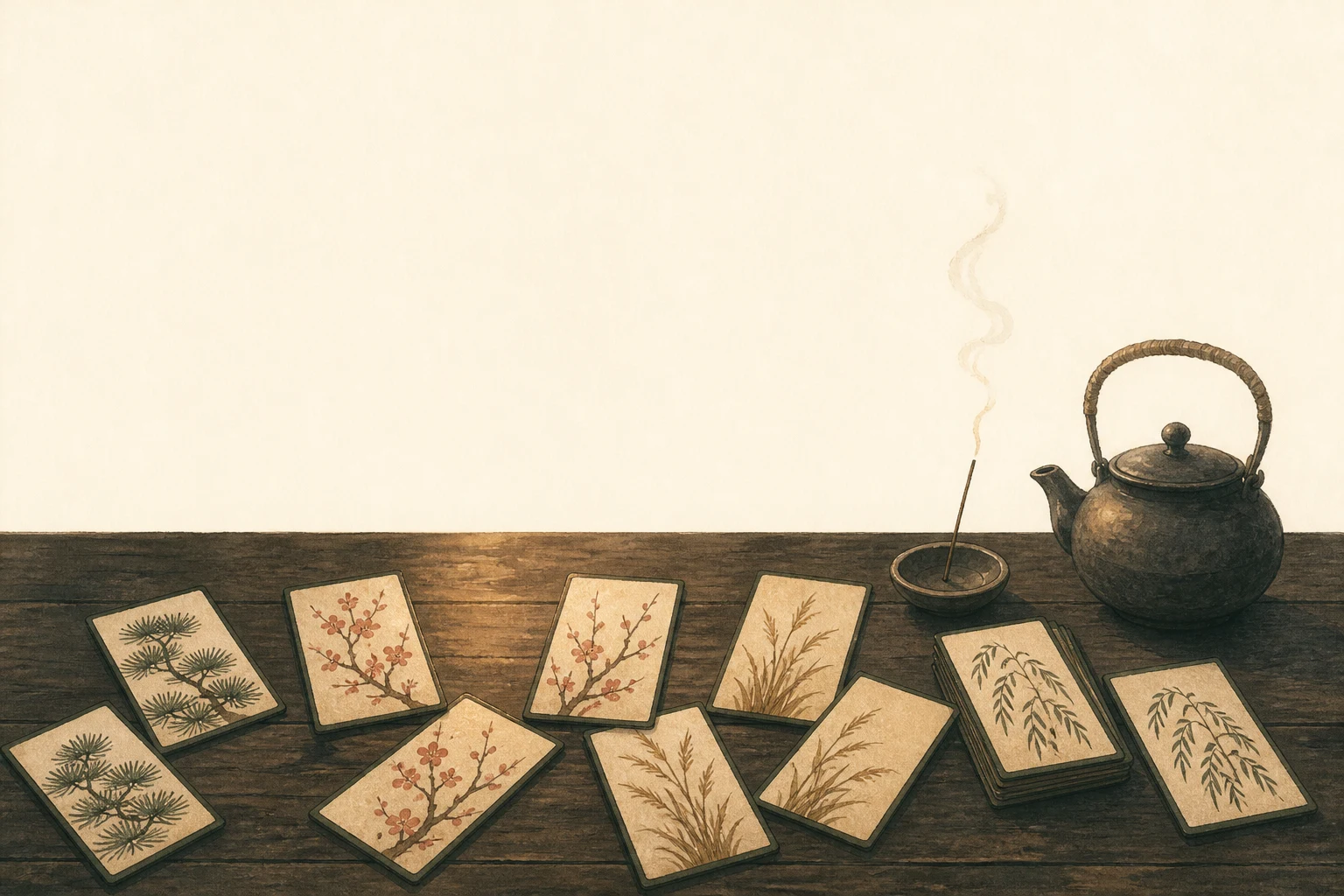
Hanafuda — the name literally means “flower cards” — are small Japanese playing cards: a deck of 48, divided into twelve suits of four, one for each month of the year, each suit built around a plant in season. January is pine with a crane; March is cherry blossom; August is silver grass under the full moon; November, the odd one out, is the willow with a man and his umbrella in the rain. There are no numbers on the faces — the months are the suits, and the pictures carry the game’s meaning. A matching game built not on arithmetic but on a calendar of flowers: that is the whole idea, and it has been charming people since the late 1700s.
How the deck was born. The history is a small masterpiece of adaptation. Western playing cards arrived with Portuguese traders in the 1500s, swept Japan, and were repeatedly banned by authorities who correctly identified gambling as their primary use case. Cardmakers responded the way creatives always respond to a ban: they redesigned around it. If numbered cards were illegal, make cards with no numbers — just pictures, just flowers, nothing a magistrate could count. Hanafuda emerged from exactly this cat-and-mouse in the Edo period. One of the companies that manufactured them, founded in Kyoto in 1889 to print exactly these cards, was Nintendo. Before it was a video game company, it was a hanafuda company — the deck is that deeply woven into Japanese visual culture.
Why the art matters. Hanafuda’s design vocabulary is one of the most refined compression systems in all of card art. Four cards per month must carry: the plant, the mood of the season, and the card’s rank in the game — and artists solved it with motifs rather than text. The sun or moon disc that appears on certain months. The red-and-gold clouds that quietly mark a card as special. The tiny human figures — poet, sake cup, umbrella man — who turn a botanical specimen into a scene. The result is a deck where every card is simultaneously a game piece, a calendar page, and a miniature painting. Collectors who will never play a single hand buy decks just to look at them, which tells you the art succeeded on its own terms.
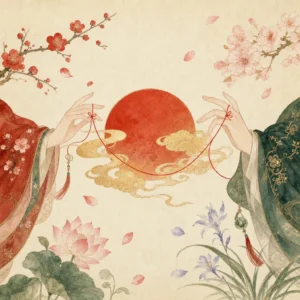
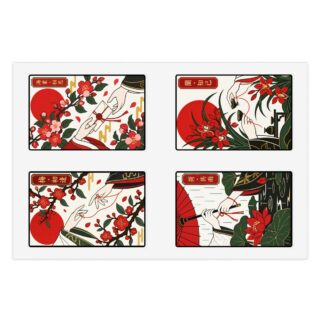
Our stickers: the format, borrowed for a love story. Our Hanafuda Sticker Collection keeps the deck’s bones and changes the payload. The tall card proportions stay; the red sun and the gold clouds stay; the seasonal plant still anchors each design. But where the traditional deck encodes a month, our four designs encode a stage of falling in love — each titled in Chinese after its flower and its phase. Plum — First Meeting: two hands tying a red thread between them, early plum in bloom. Crabapple — Longing: one hand passing a letter bound in red cord. Lotus — Sharing Rain: two hands on one umbrella handle, lotus pond below. Orchid — Kindred Spirits: two hands raising tea cups, the red thread still tied. Four cards, four seasons of a relationship, told entirely through hands — the deck’s oldest rule (show the season, hide the arithmetic) applied to a romance.
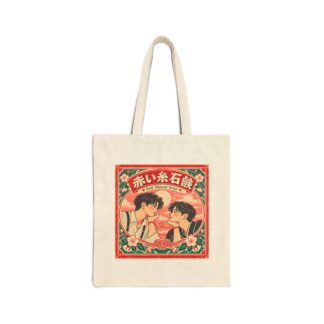
The red thread, for the record. Readers of our shop will recognize the cord running through all four designs. The red thread of fate — the invisible line said to tie destined lovers together, ankle to ankle — is a Chinese motif older than the deck that frames it here; the hanafuda form is Japanese; the romance is universal. That layering is deliberate. Flower cards traveled across borders for centuries, redesigned around every ban and every fashion, and stayed beautiful through all of it. If you want the same red thread somewhere bigger than a sticker, the Red Thread Soap tote is the same idea at bag scale: a vintage soap label that reads akai ito sekken (“red thread soap”) over two men leaning toward each other, one pink heart between them, sakura in the corners, and a tied red string running along the bottom edge. Sticker for the laptop, tote for the day — both carrying the same small, seasonal argument that two people belong together.
Three finishes, one decision. The sticker collection comes in white, holographic, or transparent. Transparent disappears into a laptop lid — only the red suns and the hands show. Holographic flares the same red under office light, which is either a feature or a workplace hazard depending on your desk. White is the most like the original cards: the full cream card face, borders and all. And because hanafuda is a game you actually play, a word on use: our stickers borrow the art format, not the rules — for koi-koi nights, buy a real deck; for everything else, these.
FAQ
Q: What do the titles on the stickers say?
Each design pairs a flower with a phase, titled in Chinese: mei (plum) — first meeting, haitang (crabapple) — longing, he (lotus) — sharing rain, and lan (orchid) — kindred spirits. Together they read as the four seasons of one relationship.
Q: Can you actually play hanafuda with these?
The stickers borrow the art format, not the game — there are four designs, not the 48 cards a hanafuda deck needs, and no point values. For play, buy a real deck; for decoration, these.
Q: What are the sticker material options?
Three finishes: white, holographic, or transparent. Transparent is the quietest on a laptop lid; holographic makes the red suns flare under light.
Q: Are hanafuda Japanese or Chinese?
The deck is Japanese, born in the Edo period from the ashes of banned Western cards. Our sticker collection layers it with a Chinese motif — the red thread — which is the kind of border-crossing the format has been doing for centuries.
Q: Is the red thread on the tote the same as the stickers’?
Same motif, different scale: the tote turns a vintage soap label into the red-thread-of-fate joke — two men, one heart, sakura, and a tied string along the bottom edge. Sticker and bag are separate products, same romance.