

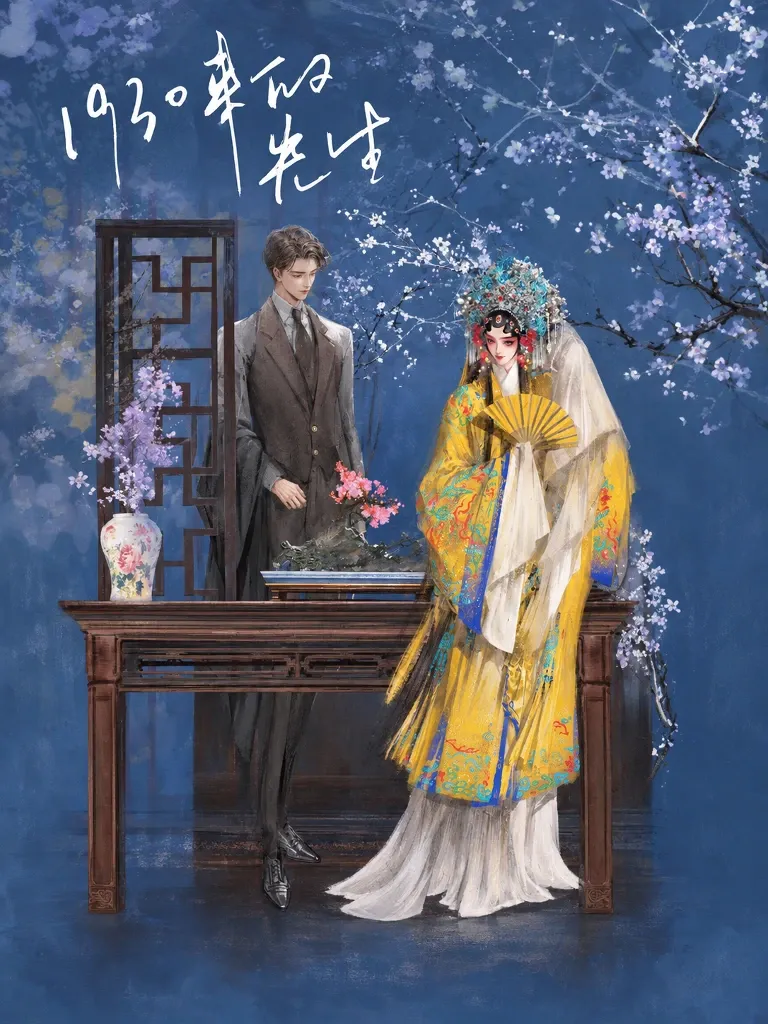
The Man Who Came From 1930
TAGSdanmei18+moderntime travelshowbizcomedypatron and artisttransmigrationdevoted love interests
A small-time model desperate to become famous finds a wealthy patron with an extraordinary secret: the gentleman helping him navigate modern show business has arrived from 1930, carrying a love story that ended in blood.
Chinese Title · 1930来的先生 / 1930來的先生
Pinyin · Yi Jiu San Ling Lai De Xian Sheng
Common English Title · The Man Who Came From 1930
Also Known As · The Man From 1930
Author · Bai Yun Shi Shi Shi (白云诗诗诗), also credited as Bai Yun Shi (白云诗 / 白雲詩)
Original Publication · JJWXC · Began September 1, 2016 · Complete · 89 main chapters and 9 extras in the current chapter list · Approximately 381,000 Chinese characters
❤️ Main Relationship
Jin Shi'an (金世安) × Bai Yang (白杨)
A cultivated businessman from Republican-era Nanjing × an ambitious, inexperienced modern model trying to become a star.
Their arrangement begins with a secret and an exchange of practical help. Bai Yang can explain the modern world; Jin can provide access, protection, and resources. Developing that arrangement into love requires them to see one another beyond usefulness, appearances, and the history Jin has brought with him.
✨ Introduction
In 1930 Nanjing, Jin Shi'an belongs to a wealthy family whose prosperity depends on dangerous political relationships. His connection to the performer Bai Lusheng ends violently. When Jin next encounters the world, he is living in a modern body bearing his own name, surrounded by unfamiliar technology, manners, and expectations. His commercial experience has not vanished, but knowing how to negotiate with powerful people does not immediately teach him how to operate a car or explain his changed behavior.
Bai Yang is struggling at the opposite end of a very contemporary hierarchy. He has a handsome face, an urgent desire to be famous, and much less professional preparation than that ambition requires. Meeting Jin seems like extraordinary luck: a man with enough money and influence to help him become someone. In return, Bai becomes an interpreter of everyday modern life, letting the apparently capable businessman admit ignorance without exposing his secret to everyone around him.
That bargain opens the door to entertainment work, but opportunity and ability remain different things. Recording sessions, acting jobs, colleagues, and professional judgments expose the distance between wanting success and being ready for it. The romance grows alongside those disappointments and small improvements. Jin's patience offers Bai something more sustaining than praise, while Bai's irreverence and affection give Jin reasons to inhabit the present rather than remain emotionally stranded in his earlier life.
The past nevertheless remains active. Bai Yang's resemblance to Bai Lusheng raises an unsettling question about recognition: is he being loved for himself, or through another person's image? As the time-travel framework becomes more consequential, the book moves beyond its comic patron-and-aspiring-star premise toward identity, loss, and the difficulty of holding on to someone whose life began in another century.
🌏 Background
The main narrative takes place in the modern entertainment industry, with Nanjing providing a connection to Jin's earlier world. Music production, image-making, casting, publicity, and business decisions create a working environment around the love story. A generous sponsor can secure an opportunity, but other people still evaluate what happens inside the recording booth or in front of a camera.
The Republican-era opening supplies a different social order: family wealth, political dependence, and the precarious position of a performer within a powerful man's life. The contrast makes Jin's old-fashioned courtesy attractive without making his original world harmless.
The author explicitly describes the premise as time travel rather than reincarnation. Bai Yang and Bai Lusheng should therefore be treated as distinct characters. The connected novel Ling Long Yue develops the other side of the time-crossing framework; it is a companion narrative, not simply a renamed version of this book.
🎭 Themes & Tone
- Being loved as oneself: Resemblance makes the distinction between a living person and a remembered attachment emotionally consequential.
- Encouragement without instant transformation: Bai's ambition is sincere, but wanting a career does not spare him embarrassment, criticism, or the need to learn.
- Different kinds of competence: Jin understands money and people while relying on Bai to explain ordinary aspects of the world he now inhabits.
- Patronage and personhood: Material support can make a relationship possible while complicating whether affection feels freely chosen and individually directed.
- A present worth staying for: Small shared pleasures acquire weight beside the knowledge that an entire earlier life has become inaccessible.
- Love across an ensemble: The supporting relationships broaden the story's treatment of desire, professional authority, and emotional hesitation.
Tone · Witty, affectionate, and often domestic, with lyrical romantic passages and considerably darker material beneath the opening premise. Its warmth coexists with a painful past and later threats to the couple's shared life.
👥 Main Characters
- Jin Shi'an: The businessman displaced from 1930. His courtesy and composure can be reassuring, but they belong to a person with a complicated history rather than an untouched ideal of gentlemanly perfection. His need for help in the present makes the relationship more reciprocal than its financial arrangement first suggests.
- Bai Yang: An obscure model who wants an entertainment career before he understands all the work involved. He can be impulsive, vain, and frustrating; his friendliness and willingness to keep trying give that immaturity room to become growth.
- Li Nian: A sharp, demanding industry figure involved in developing the newcomers' careers. He brings professional skepticism to an environment where Jin is inclined to see Bai generously. His private relationship with Zhong Yue has its own emotional costs.
- Zhong Yue: A musically gifted young man working alongside Bai. His reserve and difficulty expressing himself contrast with Bai's outgoing manner, while his feelings for Li Nian complicate the life behind his creative work.
- Jiang Ruiyun: An important figure in the entertainment ensemble whose established relationships and private feelings extend the novel beyond the main couple's perspective.
- Bai Lusheng: The performer connected to Jin's Republican-era history. Understanding his circumstances matters to the opening tragedy and to the companion novel, but he is not interchangeable with Bai Yang.
✨ Iconic Quote
「谁要吻你,我只是吻一吻这秋色。」
“Who said I wanted to kiss you? I'm only kissing these autumn colors.”
🎬 Adaptations
- Live-action adaptation — He Comes from 1930: A casting call shared on November 15, 2026 identifies an adaptation of 《1930来的先生》 directed by Wen Dao (文刀), the director of Deep In (入戏). The circulated production details list 14 episodes of approximately 40 minutes each, with filming planned to begin in February 2027. The casting synopsis follows Jin Shi'an's arrival in a modern CEO's body and his relationship with the aspiring model Bai Yang.
- Mandarin audio drama: Produced by Yi Zhi Sheng / 翼之声中文配音社团. Start with Episode 1 on Maoer FM. The production credits XuanZONE as Jin Shi'an and Yang Zai (羊仔) as Bai Yang, with Jing Shui (静水) credited as planner and director.
- Chinese print: More Fate / 墨扉文化 published a two-volume Chinese edition under the author credit 白雲詩.
🔥 Why It’s Popular
- The time traveler is socially capable but practically dependent. Jin can handle an intimidating conversation while needing Bai's help with something an ordinary modern adult takes for granted. That imbalance creates comedy and gives Bai something real to contribute.
- Bai's shortcomings are allowed to be visible. An attractive face does not make every performance convincing. Readers who enjoy gradual growth have something more specific to follow than a sequence of effortless victories.
- The romance has a recognizable style. Jin's way of speaking and small acts of attention make affection feel individual. The autumn-leaf scene is memorable because the flirtation could not belong to just any generic executive.
- Show business supplies meaningful resistance. Money, marketability, artistic ability, and professional judgment overlap without becoming identical. Being supported changes Bai's opportunities before it changes what he can do with them.
- The ensemble has desires outside the main pairing. Zhong and Li's uncertainty, professional pressures, and longstanding attachments create emotional movement around the central romance.
- The second era changes the stakes of ordinary companionship. Going for a walk or explaining a piece of technology becomes part of giving a displaced person a life in the present.
📚 Reader Notes
Beginner-friendly · ★★★☆☆ · The modern romance is approachable, but the serious historical opening, shifting viewpoints, and connected identities require patience.
Angst level · ★★★★☆ · Much of the courtship is warm; the earlier tragedy, questions of substitution, supporting relationships, and later time-crossing stakes add substantial pain.
Plot complexity · Medium to high · Entertainment careers, an ensemble cast, and the relationship between two periods develop together.
Romance visibility · High · The main couple remains central, with meaningful career material and a substantial secondary relationship.
Mystery focus · Medium · The identities and consequences of the time-travel arrangement matter, although this is not a detective story.
Recommended for · Readers who enjoy courteous but playful romantic leads, imperfect protagonists growing into their ambitions, entertainment-industry ensembles, and time-travel romance with more emotional consequence than the premise initially suggests.
Pacing note · Expect early professional mistakes and periods of immaturity. The story asks readers to spend time with Bai before he becomes more capable; it is a less comfortable fit for anyone who needs an immediately exceptional protagonist.
Content notes · A violent opening involving an intimate relationship, class and financial inequality, coercive dynamics in the historical backstory, death and grief, sexual content, industry pressure, public judgment, and identity-related distress. Some original-platform chapters are currently locked.
Ending and reading order · This novel is complete and gives the main romance a happy resolution. It can be read first. Ling Long Yue expands the connected Republican-era storyline, but its own current JJWXC listing remains ongoing; the two works should not be advertised as a fully completed duology.
The star ratings are editorial reading guidance, not aggregate review scores.
✍️ Author
Bai Yun Shi Shi Shi (白云诗诗诗) is the JJWXC author credit; Bai Yun Shi / 白雲詩 appears on the Chinese print and audio editions. Other works include Ling Long Yue (玲珑月) and 《缉凶西北荒》.
The two connected novels approach the encounter between eras from different directions. Here, an earlier generation's businessman must learn to live within modern entertainment culture. In Ling Long Yue, the related figures Jin Qiuyue and Bai Lusheng anchor a much larger Republican-era narrative. The author's own descriptions emphasize their connection while also distinguishing their development and endings.
🌌 Similar IPs
- Golden Assistant · For professional dependence, entertainment work, and affection that develops alongside learning how to function in a difficult industry. Its central dynamic is star-and-assistant rather than time traveler-and-aspiring performer.
- The Eye of the Storm · For acting careers, unequal experience, and a relationship whose meaning deepens through personal history. More restrained and emotionally heavy, without the time-travel comedy.
- Mr. Dior · For executive romance, a fantastical disruption to everyday behavior, and comic domestic intimacy. It begins with an established marriage and is much lighter in its historical burden.
- Companion work: Ling Long Yue on JJWXC. It follows Jin Qiuyue and Bai Lusheng and remains listed as ongoing.
Lists


© 2026 Sumeru Labs. All rights reserved.
About Us | Privacy Policy | Terms of Use | Community Guidelines