


The night the northern army broke the city, Aster was certain he was going to die. Instead, the regent lords did the arithmetic of surrender for him: hand the young king to Kael Lovar — the Black King of the North, the man the rumors say crossed a field of white bones to take a crown — and call the result peace. So Aster becomes a treaty in human form, a puppet king delivered to the conqueror’s bedchamber with the furniture. And here the story stops being a war chronicle and becomes a comedy, because the dreaded Black King has a quirk no rumor prepared anyone for: he cannot fall asleep unless he is holding Aster. The puppet king objects. The puppet king flees — and does not get far. And the night he is hauled back, Kael Lovar puts an arm around his waist and offers, with every appearance of reasonableness: “Be my queen.” Aster, against every survival instinct, refuses. Kael considers this. “Then you be king, and I will be queen?” That is where the official summary leaves them: a conquered king, a conqueror negotiating his own surrender, and a question nobody at the treaty table thought to ask.
Why this pairing works. The conqueror-and-puppet-king setup is the oldest power imbalance in the catalogue, and this story earns it by inverting the imbalance at every point of contact. Aster holds nothing — no army, no regency, no exit — except the one thing Kael cannot conquer by force, which is sleep itself. The man who took a city in a night is negotiating, patiently and nightly, for the right to hold someone. Meanwhile the story keeps one card face-down on purpose: the way Kael looks at Aster “carries no interest in land — only the weight of someone he has known a long time.” Known from where? The summary does not say, and the summary is right not to say. A Black King who fought his way to a throne he shows no sign of wanting, aimed at a king he treats like a reacquaintance rather than a prize — the story is betting everything that you will need to know why, and it is a good bet.

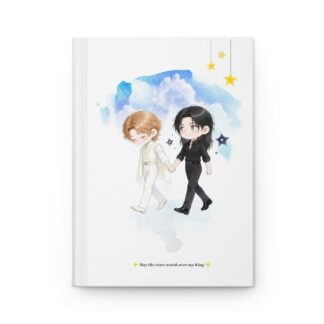
The shelf, star by star. Five pieces of merch orbit this story, and the most interesting one is the chibi royal couple hardcover journal: a soft matte cover wrapped edge to edge in watercolor — two chibi royals walking beneath clouds and hanging stars — with a sewn binding that lies open on its own and perforated lined pages for clean tear-outs. Its product title carries one more word than usual: episode activation code. The journal ships with a code tied to the series’ episode entry, which makes it the only object on this shelf that doubles as a key to the story itself — a storybook that is also, literally, a way back into the story.
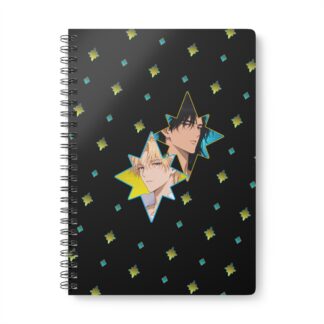
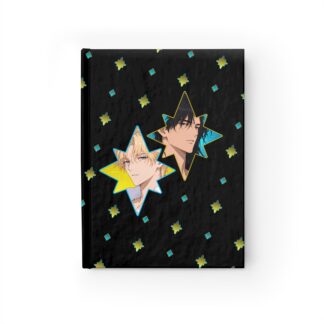
For the daily dramatic. The Starry Duo A5 spiral notebook commits to the bit completely: both leads, rendered bold against a deep black field scattered with stars, wire-o binding that lies flat, glossy cover — the notebook equivalent of entering a room while your theme music plays. Its own product copy concedes what the design already knows: this is for “all the thoughts you definitely meant to write down before getting distracted by pretty fictional men.” The hardcover sketchbook is its quieter sibling — 128 blank pages of 90gsm paper at five by seven inches, the same starry black cover keeping the fandom signal subtle enough for a meeting-room table.
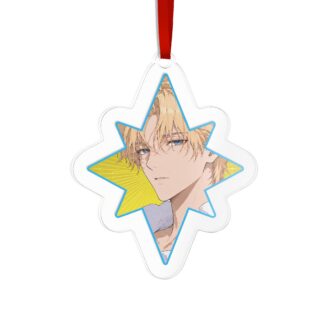
The pair that hangs apart. The two acrylic ornaments split the couple across two stars: one carries Aster’s portrait, the other carries Kael’s, each framed inside the series’ signature star motif on clear acrylic with a red ribbon for hanging. Sell them separately, hang them together — one on the holiday tree, one by the desk lamp — and let the distance between two ornaments do what the story does best: make you aware of the space, and want to close it.

Where to read. The story lives on our creations site, published there together with its writer — the treaty, the sleep quirk, and the proposal are all on the page. Fair warning applies in both directions: knowing the official summary and knowing what Kael actually wants are two different things, and the summary is very aware of the difference. So are we. Start with the proposal; the story will do the rest.
FAQ
Q: Is May the Stars Watch Over My King a romance?
Every piece of evidence says so except the official summary, which stops at the proposal and refuses to confirm anything. The merch calls them the two leads and shows them walking under hanging stars. The story, per its own introduction, is a comedy about a conqueror who cannot sleep without the king he conquered. Start reading and draw your own conclusion — that is rather the point.
Q: What is the “episode activation code” on the journal?
The chibi royal couple hardcover journal ships with a code tied to the series’ episode entry, per its product page — a physical purchase that doubles as a way back into the story. How the code is redeemed is explained on the product page itself.
Q: Which merch shows both of them together?
Three: the chibi journal walks them beneath clouds and hanging stars, the A5 notebook poses them bold against a scattered-star black field, and the sketchbook keeps the same starry pairing on a subtler cover. The acrylic ornaments are solo portraits — one per star, sold separately.
Q: Why does one ornament’s product page say “Lucian”?
The story page names the Black King Kael Lovar, and we follow the story’s spelling. One ornament’s product page carries the variant spelling “Lucian” — same character, two spellings floating around the shop. We have flagged it for cleanup; until it is unified, know that Kael and Lucian are one man.
Q: Do I need to know the story to buy the journal?
No — the journal works as an object first: soft matte cover, watercolor chibi royals, binding that lies flat, pages that tear out cleanly. But it is the one piece of this shelf that invites you back to the source, activation code included. If the cover makes you curious, that curiosity is the correct first chapter.