

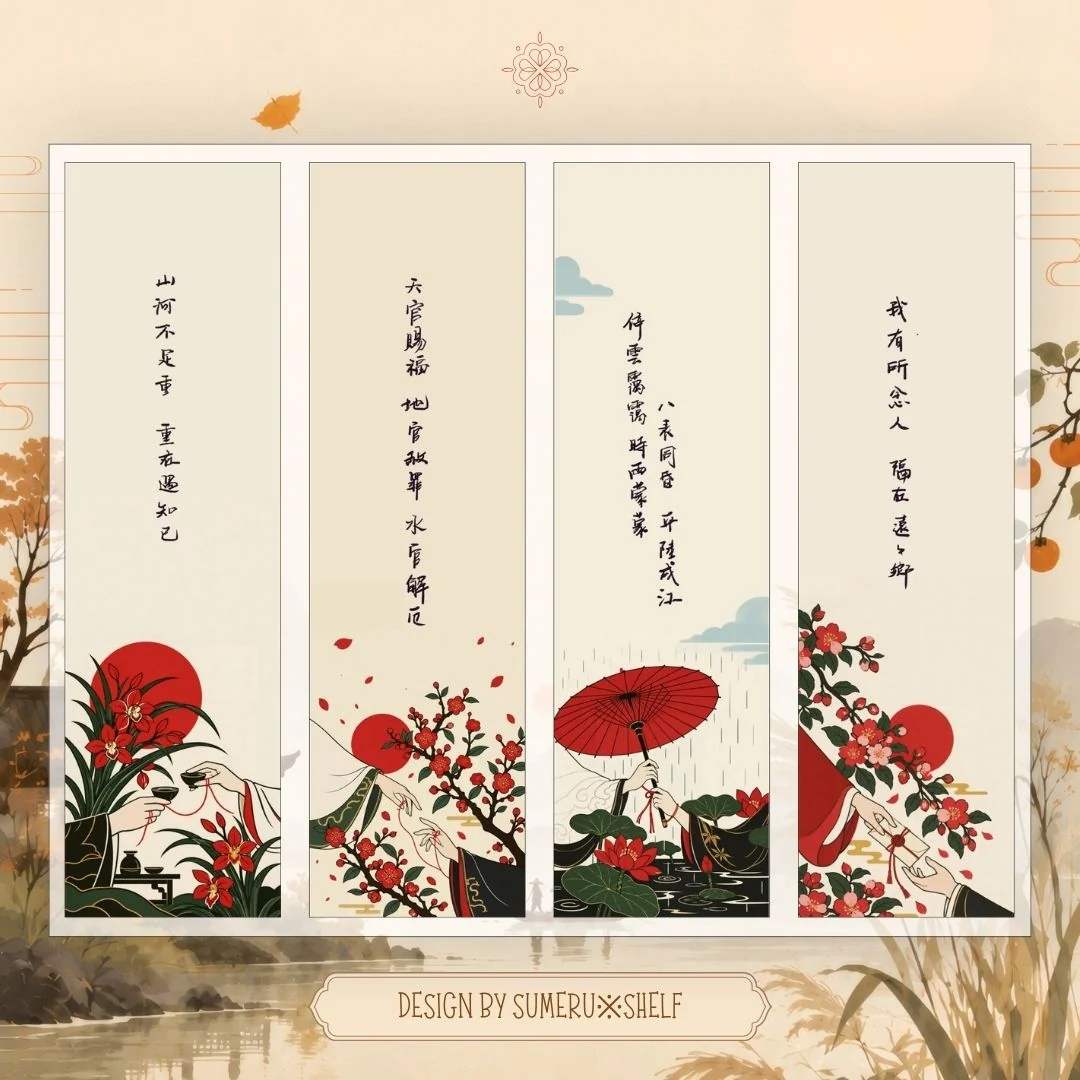
A set of four bookmark designs. The calligraphy was handwritten by Yuqing: because the scans did not turn out well this time, she wrote with a tablet instead, in running script (xingshu). The illustrations were drawn by Xiaoyu, also on a tablet, and the two were then typeset into the final layouts. Each of the four lines is quoted in a well-known Chinese danmei (BL) novel; all source texts are classical works in the public domain. This listing is a digital download — print it yourself; no physical item will be shipped.
【一】山河不足重,重在遇知己
原文(唐 · 鲍溶《壮士行》): 西方太白高,壮士羞病死。心知报恩处,对酒歌易水。沙鸿嗥天末,横剑别妻子。苏武执节归,班超束书起。山河不足重,重在遇知己。Original, translated (Ballad of the Brave Man, by Tang poet Bao Rong): High in the west hangs the White Star; a hero would be ashamed to die of illness. Knowing where his debt of gratitude lies, he sings of the Yi River over wine. A lone swan cries at the sky’s edge; sword across his back, he bids his family farewell. Like Su Wu, who came home still holding his envoy’s staff; like Ban Chao, who threw off his books to serve. Mountains and rivers count for little; what matters is meeting one who truly knows me.
The poem portrays a hero who does not fear death — only a meaningless death, before he can repay the one who believed in him. The closing couplet is the point: mountains and rivers count for little next to meeting someone who truly knows you. Priest’s novel Faraway Wanderers (《天涯客》), the source novel of the drama Word of Honor (《山河令》), takes this couplet as its theme — the bond between Zhou Zishu and Wen Kexing.
【二】天官赐福,地官赦罪,水官解厄
出处(道教三官信仰,《梁元帝旨要》): 上元为天官赐福之辰,中元为地官赦罪之辰,下元为水官解厄之辰。Original, translated (Imperial Directives of Emperor Yuan of Liang): The fifteenth of the first month is the day the Heavenly Official grants blessings; the fifteenth of the seventh, the Earthly Official pardons sins; the fifteenth of the tenth, the Water Official averts misfortune.
Daoism honours the Three Officials of Heaven, Earth, and Water: the Heavenly Official grants blessings, the Earthly Official pardons sins, the Water Official averts misfortune — each on his own festival day — making “may the Heavenly Official grant blessing” a traditional blessing phrase. Mo Xiang Tong Xiu’s novel Heaven Official’s Blessing (《天官赐福》) takes both its title and its leitmotif from this saying. The first meeting of its protagonists, Xie Lian and Hua Cheng, happens on the Lantern Festival — the very day of the Heavenly Official’s blessing.
【三】停云霭霭,时雨濛濛;八表同昏,平陆成江
原文(东晋 · 陶渊明《停云》,序及前两章): 停云,思亲友也。罇湛新醪,园列初荣,愿言不从,叹息弥襟。 霭霭停云,濛濛时雨。八表同昏,平路伊阻。静寄东轩,春醪独抚。良朋悠邈,搔首延伫。 停云霭霭,时雨濛濛。八表同昏,平陆成江。有酒有酒,闲饮东窗。愿言怀人,舟车靡从。Original, translated (Lingering Clouds, by Tao Yuanming, Eastern Jin dynasty — preface and first two stanzas): Lingering clouds — thinking of family and friends. My jars are filled with new wine, the garden rows with first blossoms; my wish goes unanswered, and sighs fill my chest. Grey linger the clouds, drizzling the season’s rain. The eight horizons share one darkness; the level road is blocked. Alone in the east veranda, I cradle my spring wine. My good friends are far away; I crane my neck, waiting. Lingering clouds mass grey, the season’s rain falls fine. The eight horizons share one darkness; the flatlands flood into rivers. I have wine, I have wine, and drink it idly by the east window. I long for those I cherish, but no boat or carriage can take me.
In his preface, Tao Yuanming writes: “Lingering clouds — thinking of family and friends.” Watching the stalled clouds and steady rain, he thinks of the people he cannot meet. “The eight horizons share one darkness; the flatlands flood into rivers” shows the rain’s force: the whole world darkens, and standing water swells into rivers. Huai Shang’s novel Breaking Through the Clouds (《破云》) is bound most closely to this poem: the names Jiang Ting and Lu Chengjiang, and the code name of the drug at the centre of the plot — “Lingering Clouds” — all come from these lines.
【四】我有所念人,隔在远远乡
原文(唐 · 白居易《夜雨》): 我有所念人,隔在远远乡。我有所感事,结在深深肠。乡远去不得,无日不瞻望。肠深解不得,无夕不思量。况此残灯夜,独宿在空堂。秋天殊未晓,风雨正苍苍。不学头陀法,前心安可忘。Original, translated (Night Rain, by Tang poet Bai Juyi): There is someone I think of, in a village far, far away. There is something I feel, knotted deep in my heart. The village is too far to reach; not a day passes that I do not gaze toward it. The knot runs too deep to loosen; not a night passes that I do not dwell on it. And tonight, by a dying lamp, I sleep alone in an empty hall. The autumn sky is far from dawn; wind and rain rage grey. Unless I learn the ascetic’s discipline, how could this heart of mine ever forget?
On a rainy night, Bai Juyi thinks of someone far away: a person he cannot let go of, in a homeland he cannot return to; a feeling he cannot untie, knotted deep inside. The poem ends: unless he learns the ascetic’s way of severing all attachment, how could this heart ever forget? Mu Su Li’s novel Copper Coins (《铜钱龛世》) quotes this line for a reunion across twelve years of life and death — “the old friend from that faraway village has finally come home.”
This listing is the digital version.
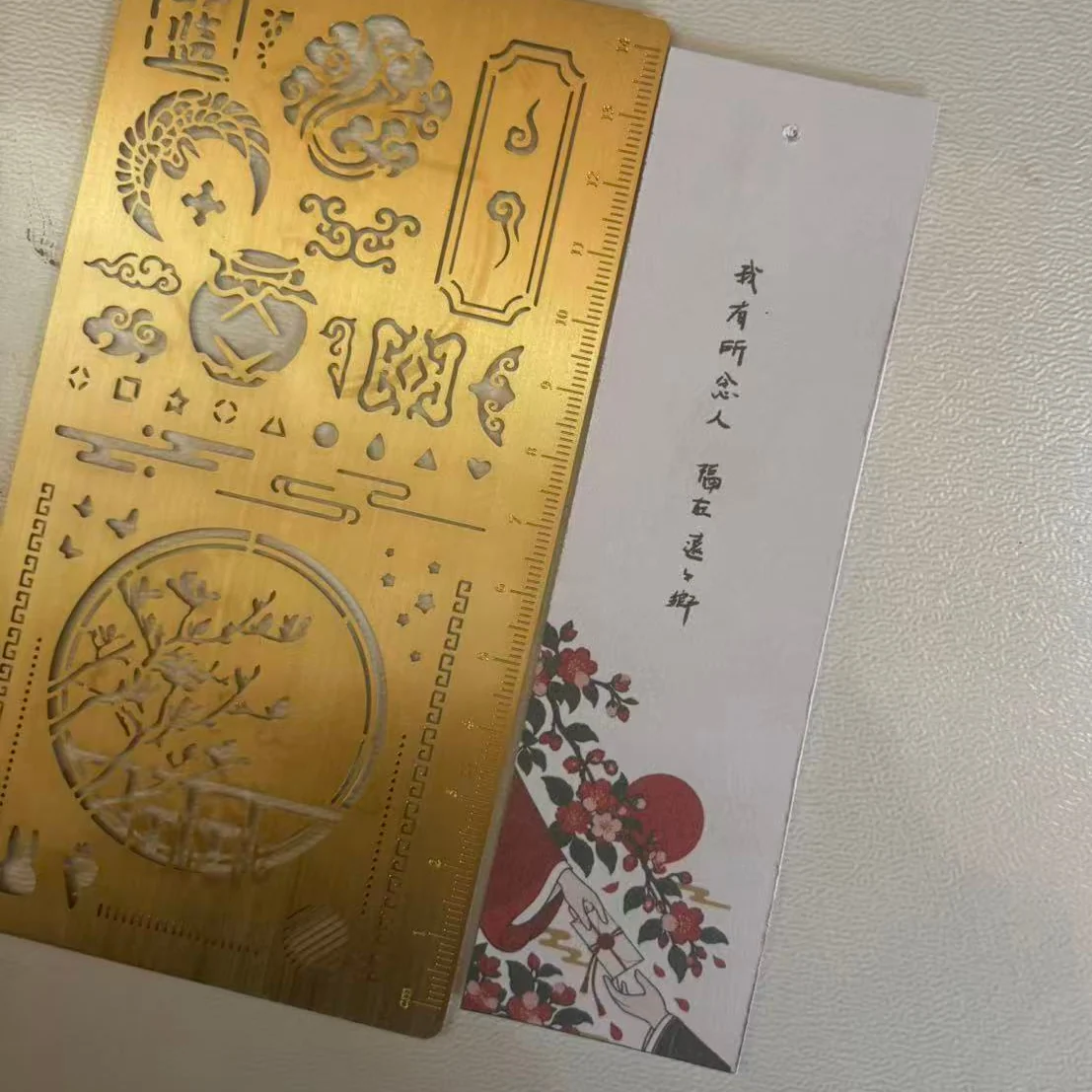
The physical version will arrive in the US (Xiaoyu’s home in NJ) in mid-December (international mail is slow). The physical bookmarks are handwritten in hard-pen calligraphy — a soft brush will not fit on a bookmark — with the script chosen at random among clerical, regular, and running script; running script is the most likely, as it is Yuqing’s everyday hand.
❗The MDZS ruler in the photos is Yuqing’s personal collection and is not included.
Features
- 4cm x 14cm
- A4 300dpi & A5 300dpi PDF
- Instant Download — Files delivered immediately after checkout.
- Re-download anytime from your email.


There are no reviews yet.