


Dual cultivation (shuāng xiū) is a trope from xianxia — Chinese cultivation fantasy — in which two partners cultivate spiritual energy together, through a bond that is usually romantic and often physical. In classic terms it borrows the language of Daoist inner alchemy: meditation, breath, yin and yang complementing each other, two practitioners refining their energy as one. In danmei, that premise becomes something better: a legitimate, in-world reason for the two leads to be intimately entangled on a regular basis, with their power levels rising in direct proportion to how badly they are failing to keep their feelings professional. The “Dual Cultivation? How to?” joke you may have seen on our tote is this trope with an exact street address — it comes from our danmei story Ghost King. Here is the trope, then the story.
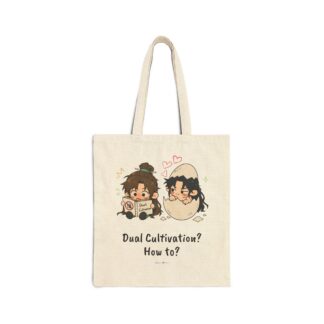
Where the joke comes from. In Ghost King, Yunxiao buys a ghost — and the shop sells it the honest way, as an egg: take it home, hatch it, keep it. His plan is domestic and blameless: a ghost to do the laundry and the cooking. The shopkeeper corrects him. This is not a housework ghost. It is a glamour ghost, and a glamour ghost is kept fed by dual cultivation with its master. Yunxiao, who has no idea what dual cultivation involves, asks the obvious question — and the shopkeeper, never one to waste a sales opportunity, sells him a copy of Dual Cultivation: From Entry-Level to Mastery, its title parodying the “XX: from beginner to expert” how-to books that fill every bookstore aisle. The chibi scene on our merch is the moment after: Yunxiao, home alone, secretly reading his new purchase, while the freshly hatched ghost leans out of his eggshell beside him — cheeks pink, hearts overhead, not worried about the curriculum at all.

The term has real roots. Xiu — the same syllable as in xiūxián, “cultivating to become immortal” — means to cultivate, practice, or repair. Daoist traditions have long spoken of paired practice: the Zhouyi Cantongqi, an alchemy text over a thousand years old, frames refinement as the union of complementary forces, and later popular novels ran with the idea until “dual cultivation” became stock vocabulary in the genre. Modern xianxia keeps the vocabulary and changes the emphasis — less esoteric diagram, more narrative engine. The important part for readers: the trope is centuries of symbolism wearing a very convenient plot.
Why danmei cannot get enough of it. Put the trope in a BL story and every inheritance of the genre ignites at once. There is the power question — who is helping whom, and what does it cost. There is the consent question, handled well or deliberately badly, both of which generate chapters. There is the comedy of two people treating an obviously romantic act as a training requirement. And there is the escalation ladder: accidental contact, deliberate practice, “just this once,” spiritual breakthrough at the worst emotional moment. Dual cultivation is basically a rom-com structure that the setting itself enforces. Writers do not have to invent reasons for the leads to keep ending up in each other’s space; the magic system does it for them.
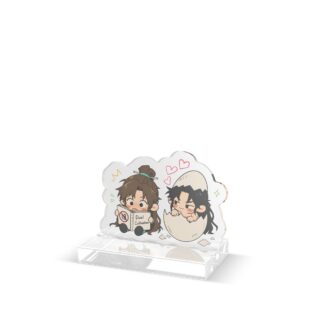
The scene on the merch. The artwork on these pieces is that exact after-moment, drawn chibi: one of the pair hunched over the shopkeeper’s upsold manual — cover stamped with a very visible “18+”, the title reading Dual Cultivation — reading with the fluster of a buyer who did not ask enough questions in the shop, while the other leans out of his cracked eggshell beside him, cheeks pink, hearts overhead, entirely unbothered. The acrylic stand sets that scene on your desk in custom-cut cast acrylic; the personalized tote and hoodie run the same artwork as a two-panel joke — the question on the front, the answer on the back.
Where the trope sits in the wider genre. If dual cultivation is your gateway drug, the neighboring shelves are worth a walk. Xianxia is the umbrella — cultivation, sects, tribulations, ascension. Wuxia is its martial cousin: no immortality, just kung fu, jianghu, and oaths. Within xianxia, the trope tends to appear wherever romance is allowed in the door, which is exactly why the danmei corner of the shelf uses it so heavily. Our own The Silver Fox’s Tribulation plays in the same sandbox from the villain’s seat — a nine-tailed fox who wakes up knowing the world is a novel and that he is fated to die by the protagonist’s sword. Same cosmology, different panic. We have a whole guide to the setting if the vocabulary is new; start there, and the jokes get better on the reread.
FAQ
Is dual cultivation always explicit?
Not necessarily. In classic xianxia it is often just paired meditation or energy exchange. Danmei frequently flirts with — or leans fully into — the physical reading, which is where most of the fandom jokes come from. Context decides.
What’s the difference between xianxia and wuxia?
Wuxia is martial arts fiction — skilled fighters, jianghu underworld, no magic immortality. Xianxia adds cultivation: characters train to transcend mortality, pass tribulations, and ascend. Dual cultivation belongs to the xianxia shelf.
Where can I read the story on the merch?
The “Dual Cultivation? How to?” scene is from Ghost King, our danmei story on our creations site — thirteen episodes, first five free on the story page. Yunxiao buys a ghost (sold, inconveniently, as an egg), learns it is a glamour ghost that must dual-cultivate with its master, and is promptly sold a copy of Dual Cultivation: From Entry-Level to Mastery. The two-state artwork is printed on a personalized tote, hoodie, desk acrylic stand, and sticker.
What should I write if I personalize the tote?
Pairs work best — a before/after, a question and its answer, or your ship’s name split across the two sides. Short lines sit better under the artwork, and the design tool shows a live preview before you save.